5 Breakthroughs in WebAssembly Speculative Optimizations with Chrome M137
Google Chrome M137 introduced two powerful speculative optimizations for WebAssembly (Wasm): deoptimization support and speculative call_indirect inlining. Together, they enable the V8 engine to generate faster machine code by making educated guesses based on runtime behavior. This is a big deal because WebAssembly has traditionally relied on static, ahead-of-time compilation, but these new techniques unlock significant speedups—especially for garbage-collected Wasm (WasmGC) programs. In this article, we break down the five key aspects of these optimizations and what they mean for developers and users.
1. The Game-Changing Role of Speculative Optimizations
Speculative optimizations have long been a secret weapon for JavaScript JIT compilers, allowing them to generate highly optimized code by assuming certain behaviors based on past executions. For example, when adding two variables, the compiler might assume they are integers and skip generic handling for strings or floats—boosting speed dramatically. If the assumption later breaks, the engine performs a deoptimization (deopt) to fall back to slower, safe code. WebAssembly historically didn't need this because its statically typed nature and source languages (C, C++, Rust) produced well-optimized binaries already. However, with the arrival of WasmGC, which adds high-level types like structs and arrays, dynamic feedback becomes valuable. This shift marks the first time V8 applies speculative techniques to Wasm at scale.
2. How Deoptimization Enables Bold Assumptions
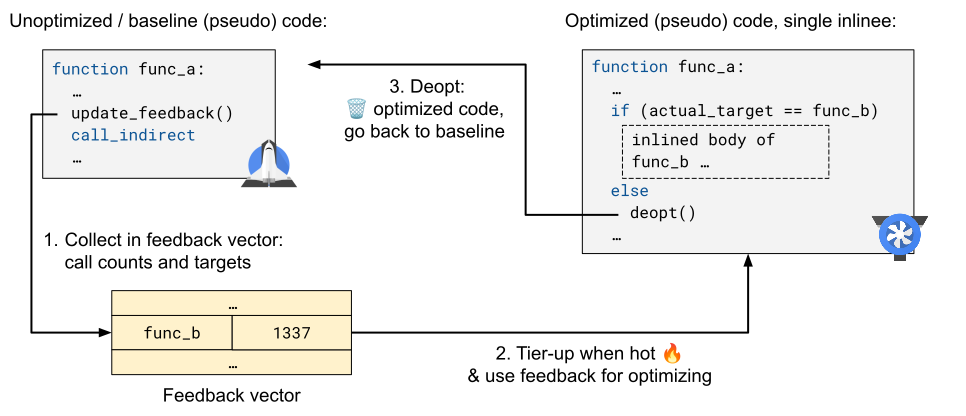
Deoptimization, or deopt, is the safety net that makes speculative optimizations possible. When the V8 compiler makes an assumption—say, that a function will always receive a certain type—it generates lightning-fast code for that case. If the assumption fails at runtime, deopt steps in to discard the optimized code and resume execution with unoptimized code. This process is smooth and doesn't crash the program; it simply pauses to collect new feedback and may eventually re-optimize. For WebAssembly, deopt is a brand-new capability, one that allows the compiler to take risks that would have been too costly before. It's the backbone that lets V8 apply aggressive inlining and type specialization to Wasm without fear of catastrophic failure.
3. Inlining: The Power of Predicting Function Calls
Inlining is a classic optimization where a called function's body is inserted directly at the call site, eliminating the overhead of function invocation. With speculative call_indirect inlining, V8 takes this a step further: it monitors which function is most frequently called through an indirect call site and inlines that specific target. This is especially effective for virtual method calls in object-oriented languages compiled to WasmGC. The trade-off is that if the program later calls a different function, the inlined code must be deoptimized. But in practice, runtime feedback makes such predictions reliable, leading to significant performance wins. This technique, detailed in item 2, works hand-in-hand with deoptimization to ensure safety.
4. Why WasmGC Reaps the Biggest Rewards
WasmGC brings managed languages like Java, Kotlin, and Dart to WebAssembly. These languages rely heavily on dynamic dispatch, type hierarchies, and garbage collection—all of which benefit from speculative optimizations. For instance, a method call on a polymorphic object can be inlined if the runtime type is predictable. Similarly, field accesses or array bounds checks can be optimized away when common patterns emerge. In Dart microbenchmarks, the combination of deopts and inlining yielded average speedups of over 50%. Even for larger, production applications, gains ranged from 1% to 8%. These improvements make WasmGC a more competitive target for high-performance web applications, bridging the gap with native code.
5. Real-World Performance Gains You Can Expect
While the 50% boost in microbenchmarks is impressive, the real value lies in everyday applications. V8's new optimizations have been tested on industry benchmarks and real-world WasmGC programs, delivering consistent improvements between 1% and 8%. That may sound modest, but for large applications—like online IDEs, games, or data visualization tools—every percentage point shaves off load times and improves responsiveness. More importantly, deoptimization sets the stage for future speculative work: once the engine can safely make assumptions, developers can add more aggressive optimizations like type specialization, loop peeling, or vectorization. As WebAssembly continues to evolve, these foundational enhancements will unlock even greater performance.
Conclusion: Chrome M137's speculative optimizations mark a turning point for WebAssembly performance. By combining deoptimization and inlining with runtime feedback, V8 now delivers faster execution for WasmGC workloads, with gains that compound across the web. Developers compiling managed languages to WebAssembly can expect smoother, snappier applications—and a foundation for even more breakthroughs ahead. As the Wasm ecosystem grows, these techniques will ensure that performance keeps pace with innovation.