Critical Clean Room Equipment Installed for Roman Space Telescope at Kennedy
New Equipment Enhances Cleanliness for Sensitive Observatory
On April 27, technicians at NASA’s Payload Hazardous Servicing Facility (PHSF) at Kennedy Space Center in Florida took delivery of eight high-efficiency particulate air (HEPA) wall modules and other ground support equipment. Each 1,800-pound module is designed to upgrade the clean room systems within the PHSF, ensuring the facility meets the exceptionally strict cleanliness standards required for processing the Nancy Grace Roman Space Telescope. The observatory will undergo critical prelaunch operations inside this facility, including spacecraft fueling, before being transported to the launch pad.
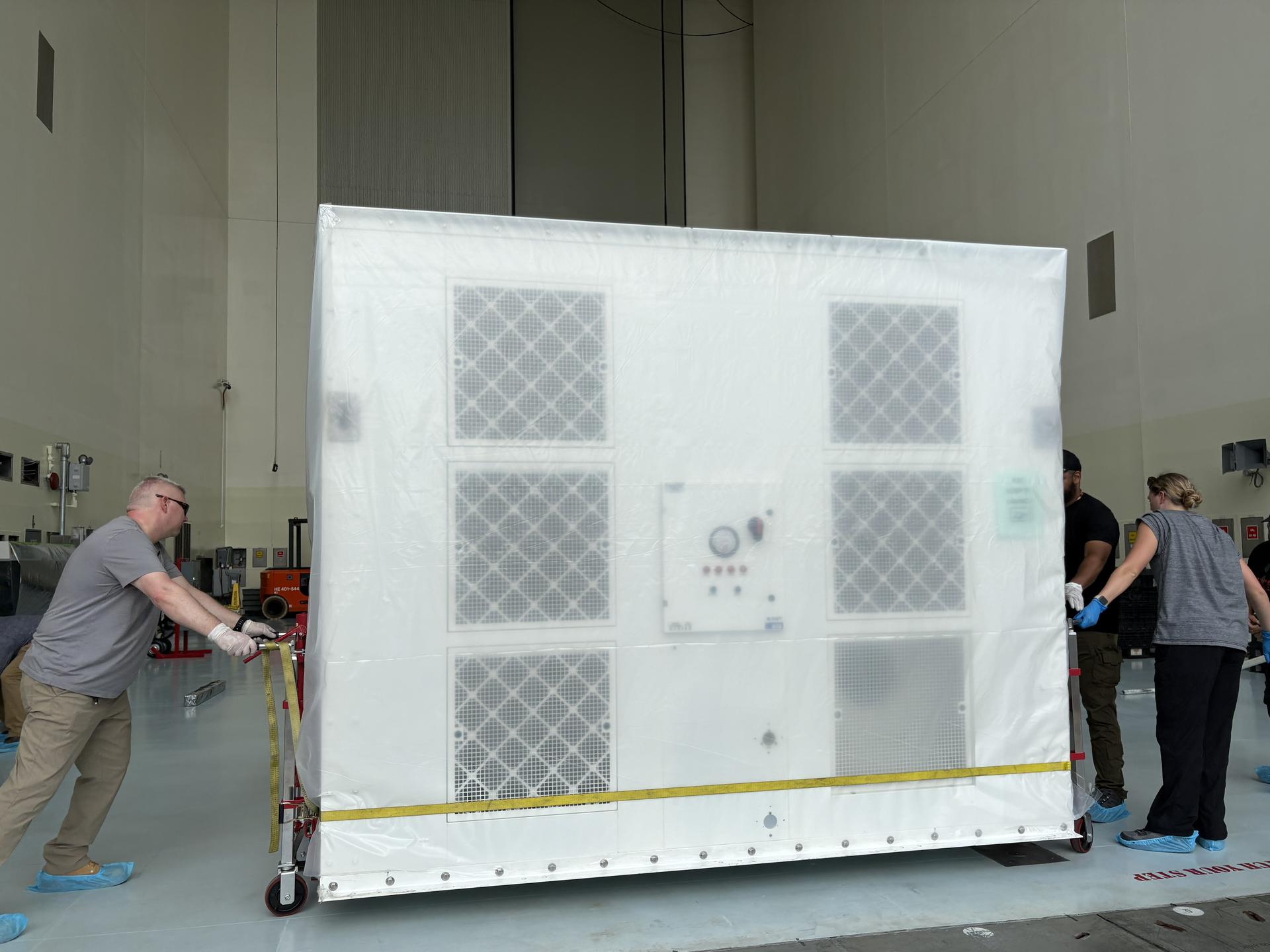
The arrival of this equipment marks a significant step in preparing the Roman mission for its upcoming launch. The HEPA modules will help filter out microscopic particles that could contaminate the telescope’s sensitive instruments, preserving their ability to capture pristine infrared light from deep space.
Understanding the Roman Space Telescope’s Mission
The Roman Space Telescope is designed to observe the universe in infrared light, using two primary instruments: the Wide Field Instrument and a Coronagraph Instrument technology demonstration. Its wide field of view will produce panoramic images that are essential for studying some of cosmology’s most profound questions, including the nature of dark energy—the mysterious force driving the accelerated expansion of the universe.
Investigating Dark Energy and Cosmic Expansion
By employing multiple complementary techniques, Roman will chart how the universe has evolved over cosmic time. Astronomers expect the mission to provide new insights into why the universe’s expansion appears to be accelerating. These observations will help refine models of dark energy and may lead to breakthroughs in our understanding of fundamental physics.
Advancing Exoplanet Science and Dark Matter Mapping
Beyond dark energy, Roman will revolutionize the study of exoplanets by directly imaging and characterizing worlds beyond our solar system. It will also map the structure and distribution of both normal matter and dark matter across space and time, offering a more complete picture of the cosmos. This dual focus on the largest and smallest scales makes Roman one of the most versatile space observatories ever built.
Launch Preparations and Timeline
Teams are targeting launch as soon as early September. The telescope will ride a SpaceX Falcon Heavy rocket from Launch Complex 39A at NASA Kennedy. The arrival of the HEPA modules ensures that all ground processing can proceed without delays caused by contamination concerns.
The Role of the Payload Hazardous Servicing Facility
The PHSF is a specialized clean room complex designed to handle hazardous payloads and sensitive spacecraft. Its upgraded air filtration system will maintain ISO Class 7 cleanliness levels (or better) during Roman’s processing. This environment is crucial because even a single particle of dust or a stray oil molecule could degrade the performance of the telescope’s infrared detectors or obscure its optics. The new HEPA wall modules work alongside existing systems to create a nearly particle-free workspace.
In addition to the wall modules, other ground support equipment delivered on April 27 will assist technicians in moving, inspecting, and servicing the telescope components safely. Each piece of equipment undergoes rigorous certification to ensure it does not introduce contaminants.
Why Cleanliness Matters for Infrared Astronomy
Infrared telescopes are particularly vulnerable to contamination because warm objects emit infrared radiation. A speck of dust warmer than the surrounding environment can create false signals that mask or mimic astronomical targets. By maintaining extreme cleanliness, the PHSF helps preserve Roman’s ability to detect faint heat signatures from billions of light-years away, enabling studies of the universe’s earliest galaxies and the formation of stars and planets.
The investment in this upgraded equipment reflects NASA’s commitment to ensuring the Roman mission achieves its groundbreaking science goals. As launch approaches, each piece of infrastructure—from the HEPA modules to the fueling systems—plays a vital role in the observatory’s success.
Photo credit: NASA/Leejay Lockhart