Optimizing JSON.stringify: A Deep Dive into V8's Performance Boost
Overview
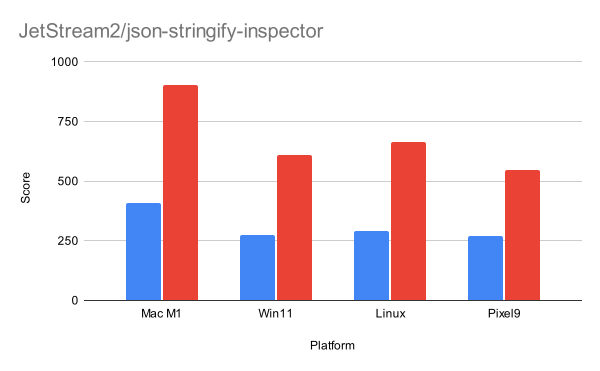
JSON.stringify is a workhorse of JavaScript: it serializes objects into strings for network requests, local storage, and many other tasks. Given its ubiquity, even a small performance improvement can have a large impact on web application responsiveness. The V8 team recently achieved a remarkable feat—more than doubling the speed of JSON.stringify. This guide breaks down the key engineering decisions behind this optimization, explaining how V8 now handles serialization more efficiently. You’ll learn about the new fast path, the shift from recursive to iterative traversal, and how V8 optimizes for different string representations. Along the way, we’ll highlight common pitfalls to avoid when writing code that relies on JSON.stringify, and how to ensure your objects can benefit from these improvements.
Prerequisites
- Basic understanding of JavaScript objects and JSON serialization.
- Familiarity with the V8 JavaScript engine (the engine behind Chrome and Node.js).
- Optional: Access to a Chrome DevTools or Node.js environment to test code examples.
Step-by-Step Guide to Understanding V8's JSON.stringify Optimization
1. The Side-Effect-Free Fast Path
The cornerstone of the speedup is a new fast path that V8 takes only when it can guarantee that serialization will not trigger any side effects. A side effect is any operation that disrupts the simple, streamlined traversal of an object. This includes executing user-defined toJSON() methods, calling getters, or even internal operations like garbage collection (GC) that might occur during string flattening. For most plain data objects—objects with no custom serialization logic—V8 can confidently stay on this fast path.
By avoiding checks for side effects, the fast path eliminates many defensive branches that the general-purpose serializer must include. The result is a substantial speed gain for the most common use cases, such as serializing API responses or configuration objects.
How to ensure your objects use the fast path:
- Avoid defining
toJSON()methods on your objects. - Use plain objects (e.g.,
{ key: value }) rather than class instances with getters. - Keep property values as primitives, arrays, or other plain objects—avoid functions, Symbols, or objects that require custom serialization.
2. Iterative vs. Recursive Serialization
The old JSON.stringify used a recursive algorithm: each nested object caused a new stack frame. This design required stack overflow checks and made handling deeply nested structures expensive. The new implementation is iterative, processing objects using an explicit stack (or a worklist). This architectural change brings two major benefits:
- No stack overflow checks. The iterative loop manages its own state, so V8 can skip the overhead of checking the call stack depth at every level.
- Faster resumption after encoding switches. When V8 encounters a string that requires switching between one-byte and two-byte handling (see next section), the iterative loop can seamlessly continue without unwinding and re-entering recursive calls.
As a result, developers can now serialize significantly deeper nested object graphs without hitting stack limits.
Example of iterative logic (simplified pseudocode):
function fastStringify(obj) {
  const stack = [{ value: obj, state: 'start' }];
  let result = '';
  while (stack.length) {
    const frame = stack.pop();
    if (frame.state === 'start') {
      // process value and push children as needed
    }
  }
  return result;
}
3. Handling Different String Representations
Inside V8, strings can be stored in one of two internal formats: one-byte (for ASCII characters only, using 1 byte per character) or two-byte (for any Unicode character, using 2 bytes per character). To avoid runtime branching on every character, the new serializer is templatized on the character type. Two specialized versions of the string-processing code are compiled: one optimized for one-byte strings, and another for two-byte strings. This doubles the binary size of the serializer, but the performance gain is well worth the trade-off.
During serialization, V8 inspects the instance type of each string. If it encounters a representation that cannot be handled on the fast path—such as a ConsString (a concatenated string that may require GC during flattening)—it falls back to the safe, general-purpose slow path. This ensures correctness while maximizing speed for the typical case.
Impact on your code: To benefit from the one-byte optimizations, keep your string data inside the ASCII range when possible. For example, prefer numeral IDs and English text over mixed-script content. This reduces memory and speeds up serialization.
Common Mistakes
- Assuming all objects get the fast path. If you define a
toJSON()method on an object, V8 must fall back to the slower general-purpose serializer. Only plain data objects without custom serialization logic leverage the speedup. - Ignoring string encoding. A single non-ASCII character forces the entire string to be stored as two-byte. If you frequently serialize large arrays of short strings, consider normalizing them to ASCII where possible.
- Relying on stack-unsafe depth. Even with the iterative serializer, very deep nesting (e.g., >10,000 levels) may still cause out-of-memory issues. The new implementation is improved but not infinite.
- Not checking V8 version. These optimizations are specific to V8 (Chrome, Node.js). Other engines (SpiderMonkey, JavaScriptCore) may not have the same fast paths. Test performance in your target environment.
Summary
V8’s dramatic speedup of JSON.stringify stems from three key changes: a side-effect-free fast path that bypasses defensive checks, an iterative architecture that eliminates stack overflow overhead, and character-type templatization that processes one-byte and two-byte strings with minimal branching. By understanding these optimizations, developers can write code that maximizes performance—sticking to plain objects, avoiding custom serialization methods, and keeping strings ASCII-friendly. These improvements make JSON.stringify more than twice as fast for the most common use cases, leading to snappier web applications and a better user experience.