Boosting WebAssembly Performance with Speculative Optimizations and Deoptimization
WebAssembly execution in V8 has taken a significant leap forward with the introduction of speculative optimizations and deoptimization support, shipped in Google Chrome M137. These advancements, specifically speculative call_indirect inlining and deoptimization, leverage runtime feedback to produce more efficient machine code. The result is a substantial performance boost, particularly for WasmGC programs—up to over 50% faster on Dart microbenchmarks and 1–8% improvement on larger, real-world applications. This article explores how these optimizations work and why they matter for the evolving WebAssembly ecosystem.
Background: Why WebAssembly Now Needs Speculative Optimizations
The Role of Runtime Feedback in JavaScript
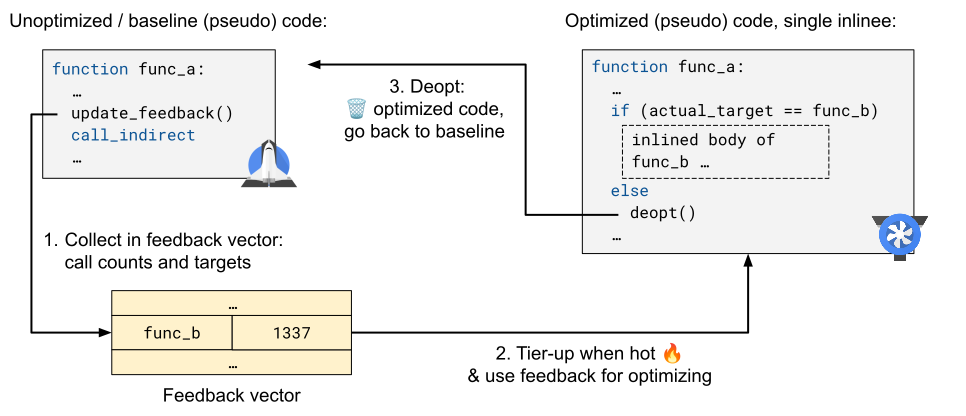
Fast execution of JavaScript has long depended on speculative optimizations. In V8, the JIT compiler collects feedback from earlier executions—for example, noting that both operands of a + b are integers. It then generates machine code optimized for integer addition, avoiding the overhead of generic code that handles all data types. If subsequent behavior violates these assumptions, V8 performs a deoptimization (or deopt): the optimized code is discarded, and execution continues in unoptimized code while collecting fresh feedback for future re-optimization.
The Static Nature of Early WebAssembly
Historically, WebAssembly did not require such speculative tricks. Programs compiled to WebAssembly from C, C++, or Rust already carry abundant static information: functions, instructions, and variables are statically typed. Ahead-of-time optimizers like Emscripten (based on LLVM) or Binaryen produce well-optimized binaries. As a result, the need for runtime feedback-driven optimizations was minimal—at least for the original WebAssembly 1.0 spec, which has been available since 2017.
The Motivation: WasmGC Changes the Game
WebAssembly has evolved. The WasmGC (Garbage Collection) proposal extends the standard to better support managed languages such as Java, Kotlin, and Dart. WasmGC bytecode is more high-level than WebAssembly 1.0: it introduces rich types like structs and arrays, subtyping, and operations on these types. Generating efficient machine code for such abstractions is harder without runtime feedback. Speculative optimizations become essential to narrow down concrete types and enable aggressive inlining.
High-Level Types and Subtyping
With WasmGC, a variable might hold an object that could be one of several subtypes. Without speculation, the compiler must emit generic dispatch logic—slower and larger. By collecting feedback on actual types at runtime, V8 can assume the most common subtype and generate specialized, fast code. If that assumption later fails, a deopt safely falls back.
Key Optimizations: Speculative Inlining and Deoptimization
Speculative call_indirect Inlining
One critical optimization is speculative inlining of call_indirect. In WebAssembly, indirect calls through function tables are common. Without speculation, each indirect call requires a dynamic check to verify the target function signature. V8 now uses runtime feedback to predict the most likely target function and inlines it directly. This eliminates the call overhead and enables further optimizations like constant propagation. When the prediction is wrong, a deoptimization restores correctness.
Deoptimization Support for WebAssembly
Deoptimization is the safety net that makes speculation viable. When code generated under assumptions encounters a situation that violates those assumptions—for instance, a different function is called indirectly, or a variable now holds a different type—the deoptimization mechanism seamlessly transfers execution back to unoptimized, but correct, code. This is not a new concept for JavaScript, but its addition for WebAssembly required careful engineering to handle the different execution model and binary format.
Performance Impact and Future Potential
Combining speculative call_indirect inlining with deoptimization yields impressive results. On Dart microbenchmarks, the speedup averages more than 50%. For larger, more realistic applications and benchmarks—such as those from the Dart ecosystem and other WasmGC programs—the improvement ranges from 1% to 8%. While smaller in percentage, these gains are significant in absolute terms and come with minimal code size increase.
Beyond the immediate speedup, deoptimization is a foundational building block. It opens the door for even more aggressive optimizations in the future—such as speculative type specialization, loop unrolling, and adaptive inlining—that were previously impractical without a fallback mechanism.
As WebAssembly continues to expand beyond its static-language roots, speculative optimizations will play an increasingly vital role in ensuring near-native performance for a wider range of programming languages and use cases.