Mastering Secret Lifecycle Management: Why Vault Secrets Operator Leads on Kubernetes
Platform teams managing Kubernetes often hit a security wall when scaling environments: native Kubernetes Secrets lack enterprise-grade governance, rotation, and revocation. As clusters multiply across clouds, the question evolves from 'how to inject a secret' to 'how to manage its entire lifecycle without slowing development.' Centralized secret management is now table stakes, and HashiCorp Vault—especially on Red Hat OpenShift—has become the standard. But multiple integration patterns exist, each with operational and security tradeoffs. This FAQ demystifies the options and explains why the Vault Secrets Operator (VSO) is the modern recommended approach for seamless, automated secret lifecycle management.
Why Aren’t Native Kubernetes Secrets Enough for Enterprise Needs?
Native Kubernetes Secrets are stored in etcd, often base64-encoded (not encrypted at rest by default), and lack fine-grained access controls. More importantly, they offer no built-in mechanism for secret rotation, revocation, or lifecycle management. As environments grow, manual updates become error-prone and slow. Enterprises need a centralized vault that enforces policies, audits access, and rotates secrets automatically—capabilities absent from vanilla Secrets. Additionally, secrets often must be shared across Kubernetes and non-Kubernetes workloads (e.g., VMs, databases), making a platform-agnostic solution like Vault essential. Without it, teams risk security gaps and developer bottlenecks.
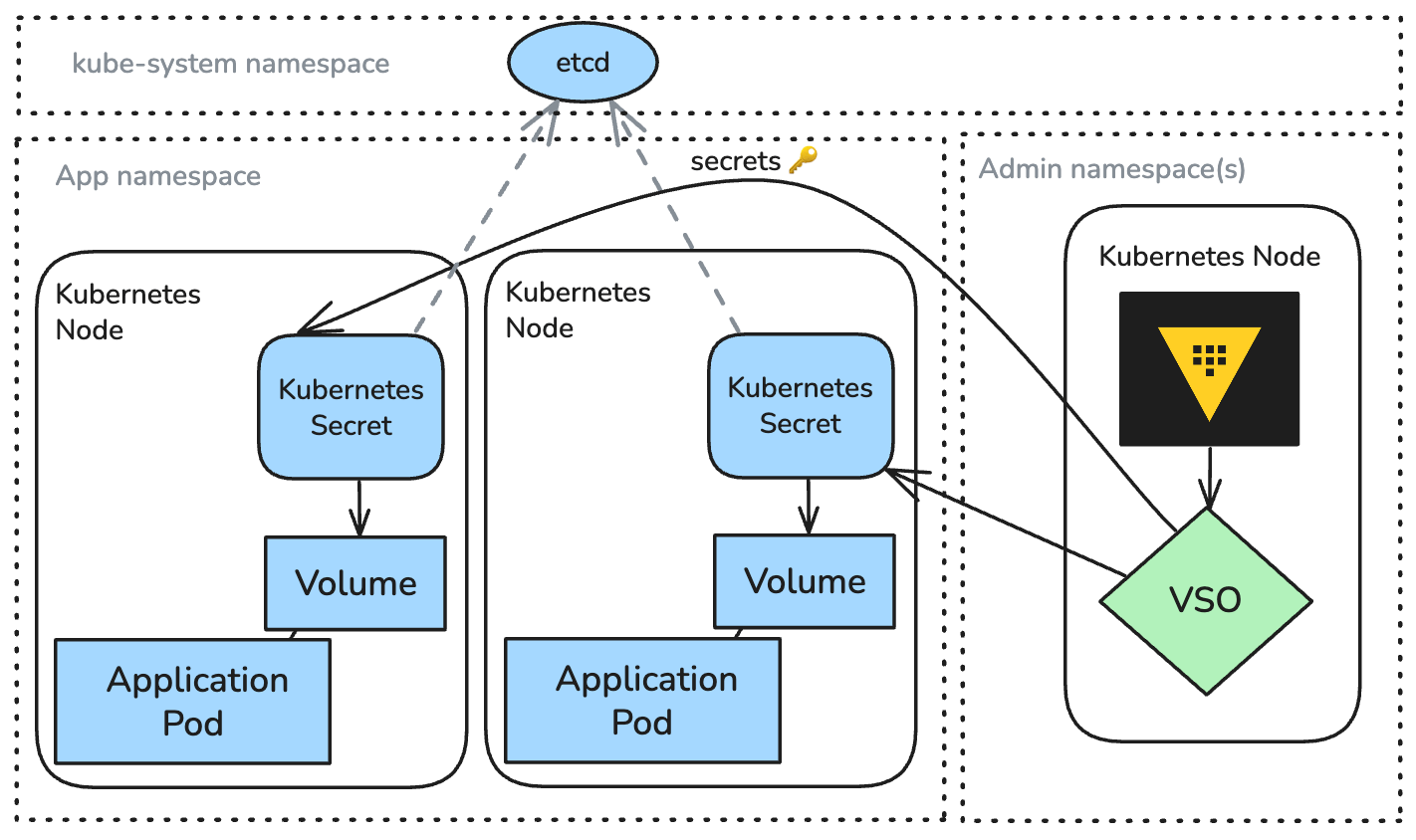
What Is the Vault Secrets Operator (VSO) and How Does It Work?
The Vault Secrets Operator (VSO) is a Kubernetes-native operator that synchronizes secrets from HashiCorp Vault into native Kubernetes Secrets. Instead of injecting secrets via sidecars or CSI volumes, VSO watches for custom resources (e.g., VaultSecret) and automatically creates or updates the corresponding Secret objects. This means your pods can continue using familiar Kubernetes Secrets (environment variables, volumes, etc.) without any code changes. VSO handles the entire lifecycle: generation, injection, rotation, and revocation. It also integrates with OpenShift security context constraints (SCCs), making it a drop-in solution for existing clusters. The operator is actively maintained by HashiCorp and deeply integrated with the Vault ecosystem.
How Does VSO Compare to the Vault Agent Sidecar Injector?
The Vault Agent Sidecar Injector was historically the first robust solution. It mutates pod definitions to inject a sidecar container that authenticates with Vault and writes secrets to a shared volume. While functional, this approach introduces additional container overhead, requires pod mutations, and adds complexity in debugging. VSO, by contrast, is declarative and operates at the cluster level: it creates Kubernetes Secrets that any pod can consume. This removes the need for a sidecar entirely. However, the sidecar injector may still be useful for legacy workloads that cannot be refactored, or where secrets must be retrieved dynamically at pod startup. For most modern use cases, VSO is simpler and more efficient.
What About the Secrets Store CSI Driver? Is It Still Relevant?
The Secrets Store CSI Driver mounts secrets from an external store (like Vault) as a volume in the pod. It works well for read-heavy workloads and avoids storing secrets in etcd. However, it requires installing and configuring the CSI driver, and secret updates require remounting or pod restart. VSO offers a built-in CSI companion driver (VSO Protected Secrets) that combines the benefits: use VSO to synchronize a secret, then optionally mount it via CSI for automatic rotation without pod restarts. This hybrid approach is the best of both worlds. Standalone CSI drivers remain viable but introduce more moving parts; VSO’s CSI companion simplifies the setup while keeping the security advantage of volume mounts.
What Are the Key Security Tradeoffs Between Integration Methods?
Each method has a different blast radius. With the sidecar injector, every pod runs a Vault agent – if an agent is compromised, it could access secrets meant for that pod only. The CSI driver mounts secrets directly, but the volume may be read by any process in the container. VSO minimizes risk by decoupling secret synchronization from pod runtime: secrets are written to isolated Kubernetes Secrets, and RBAC controls which pods can access them. Additionally, VSO supports encryption at rest in etcd (via KMS), audit logging, and can enforce short-lived leases. For compliance-heavy environments, VSO’s approach of using native Kubernetes RBAC alongside Vault policies offers a clean, auditable trail.
Why Is VSO Now the Recommended Standard for Most Kubernetes Deployments?
HashiCorp and Red Hat have deepened their partnership (via IBM) to make VSO the first-class citizen on OpenShift and Kubernetes. VSO is Kubernetes-native, reduces operational complexity, and integrates seamlessly with OpenShift’s built-in secret encryption and security context constraints. It also supports automatic rotation without modifying pods – using either a shared volume (with the CSI companion) or by triggering reconciliation on Vault secret changes. Compared to older methods, VSO has fewer moving parts, is easier to debug, and aligns with GitOps workflows (e.g., Argo CD). For greenfield deployments or clusters already using Vault, VSO is the simplest path to enterprise-grade secret lifecycle management.
How Does VSO Handle Secret Rotation and Revocation?
VSO continuously watches the Vault path you’ve configured in its custom resource. When a secret rotates (or expires), VSO automatically updates the corresponding Kubernetes Secret object. Pods that consume the Secret via environment variables will need a restart (or use a controller like Stakater Reloader), but if you use VSO’s CSI companion driver, secrets are mounted as volumes and refreshed dynamically without pod restarts. For revocation, VSO respects Vault’s lease expiration and token revocation. You can also configure VaultAuth resources to enforce fine-grained permissions, ensuring that a deleted Vault secret is immediately removed from Kubernetes. This full lifecycle automation frees platform teams from manual intervention.