V8’s Turbocharged JavaScript: How Mutable Heap Numbers Boosts Benchmark Performance by 2.5x
JavaScript engines constantly evolve to make code run faster. Recently, the V8 team focused on the JetStream2 benchmark suite, uncovering a hidden performance trap in the async-fs test. By allowing a frequently updated numeric variable to live as a mutable heap number instead of creating a new object each time, they achieved a massive 2.5× speedup on that specific benchmark. This change not only improved JetStream2 scores but also benefits any real‑world code that mutates numbers inside hot loops. Below, we break down the optimization in a question‑and‑answer format.
What exactly did V8 optimize to get a 2.5× speedup in the async‑fs benchmark?
The async‑fs benchmark implements a JavaScript file system with asynchronous operations. Profiling revealed that its custom Math.random function was the bottleneck. The function repeatedly updated a seed variable stored in the script’s context. In V8’s standard implementation, numbers that aren’t small integers are stored as immutable HeapNumber objects. Every modification to seed forced a new HeapNumber allocation on the garbage‑collected heap, causing significant overhead. The V8 team modified the representation of ScriptContext slots so that a double‑precision float can be stored directly in the context array, making the number mutable. This eliminated the allocation entirely, yielding the 2.5× boost.
Why does the benchmark use a custom Math.random, and how does it work?
Benchmarks need deterministic, repeatable results, so the async‑fs test overrides the built‑in Math.random with a seeded pseudo‑random number generator. The custom implementation is a linear‑feedback shift register that updates a 32‑bit seed variable through six bitwise operations and finally returns a fraction between 0 and 1. The seed changes on every call, which is the critical point: each update writes a new value. In the original V8 code, that write created a fresh HeapNumber object on the heap, since the context slot only held a tagged pointer. This allocation pattern happened millions of times during the benchmark run, turning a mathematical operation into a garbage‑collection nightmare.
What is a ScriptContext in V8, and how does it store numbers?
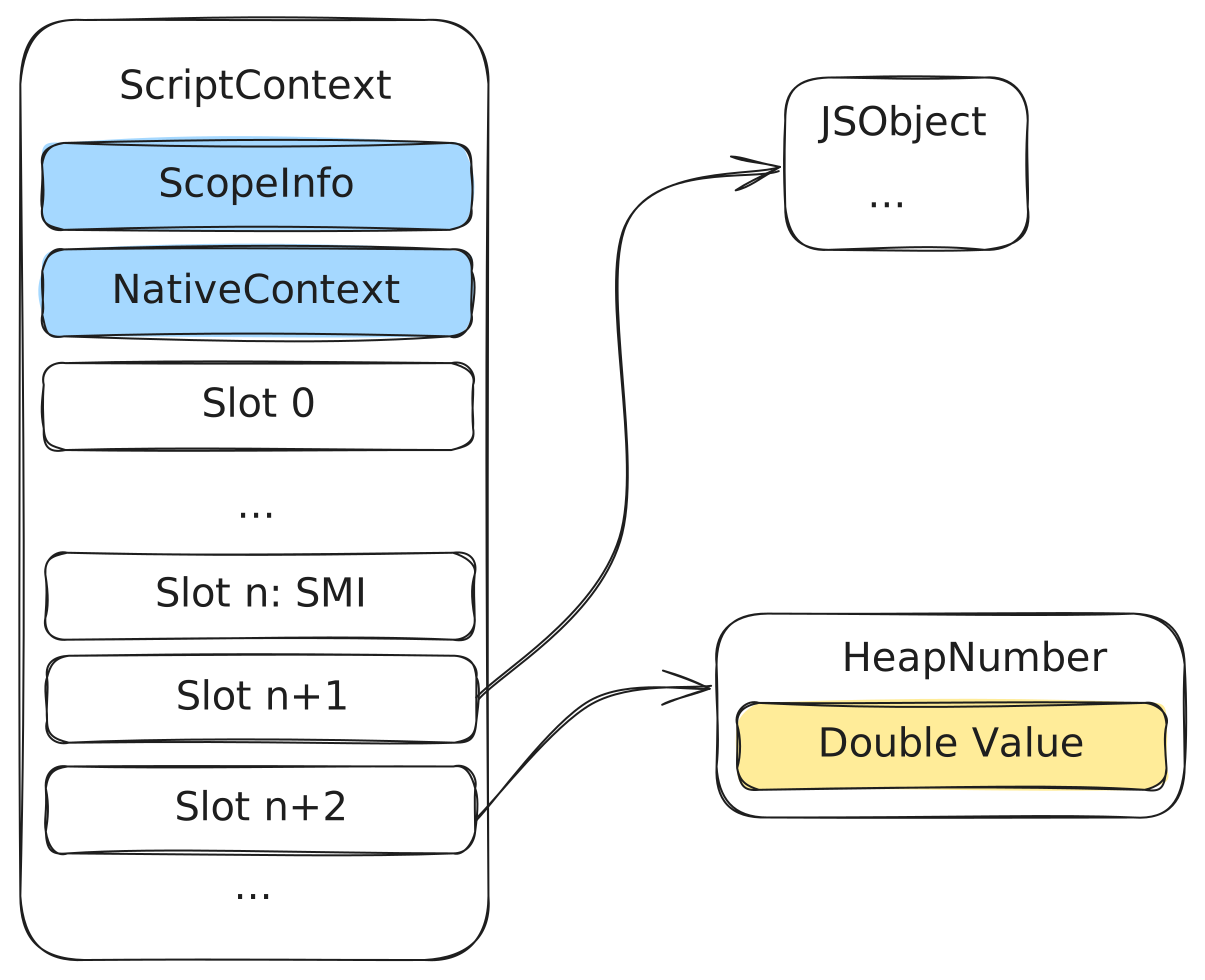
A ScriptContext is an internal array that holds variables accessible from the script’s scope (like global variables or function‐level closures). On a 64‑bit system, V8 uses compressed tagged values of 32 bits. The least significant bit acts as a tag: 0 means the value is a Small Integer (SMI) — the integer itself is stored directly, shifted left by one bit. A tag of 1 means the value is a compressed pointer to a heap object. When a number is too large or has a fractional part, V8 stores it as an immutable HeapNumber (a 64‑bit double on the managed heap) and puts the pointer into the context slot. This tagged architecture is efficient for small integers but forces indirection for most non‑SMI numbers.
How did the immutability of HeapNumber create a performance cliff?
Because HeapNumber objects are immutable, any change to the numeric value requires allocating a brand new HeapNumber and updating the context slot’s pointer. In the Math.random function, the seed variable is updated six times per call. Each update triggers a new allocation. During the benchmark, Math.random is called thousands of times per second, so the heap quickly fills with short‑lived HeapNumber objects. The garbage collector has to clean them up, adding pauses and CPU overhead. This pattern — a frequently mutated number that is not a small integer — is exactly the kind of performance cliff that V8 aims to eliminate.
What change did V8 make to the ScriptContext representation to solve this?
V8 introduced a mutable double slot inside the ScriptContext. Instead of forcing every non‑SMI number to live as an immutable HeapNumber on the heap, the engine now allows certain context slots to store a raw 64‑bit double value directly. When the compiler encounters a numeric variable that is mutated frequently and cannot be represented as an SMI (for example, because it becomes a fraction after the Math.random division), it can promote the slot to hold the double inline. This eliminates the need for heap allocation on every write. The slot still uses tagging to distinguish between SMI, pointer, and the new mutable‑double mode. The change is transparent to JavaScript code but dramatically reduces garbage‑collection pressure.
How does this optimization relate to TurboFan and real‑world applications?
TurboFan, V8’s optimizing compiler, is responsible for detecting patterns where mutable double slots can be used. During profiling, TurboFan identifies variables that are updated very often and are not small integers. It then emits code that reads and writes the double directly in the ScriptContext, avoiding the HeapNumber detour. While the async‑fs benchmark exposed the issue, the pattern appears in real‑world code — for example, in Monte Carlo simulations, game physics, or financial calculations that update floating‑point accumulators inside tight loops. V8’s fix therefore benefits any JavaScript application that mutates a fractional number thousands of times per second.
What was the overall impact on JetStream2 and why does it matter?
The async‑fs benchmark alone contributed a 2.5× improvement, which helped raise V8’s overall JetStream2 score by several percentage points. For web users, this means faster page loads and smoother interactions on sites that rely on file‑system‑like operations or heavy numeric computation. More importantly, the optimization showcases V8’s ongoing commitment to removing performance cliffs — unexpected slowdowns caused by implementation details that modern JavaScript patterns trigger. By making heap numbers mutable in context slots, V8 ensures that high‑performance code stays fast regardless of how numbers are mutated.